
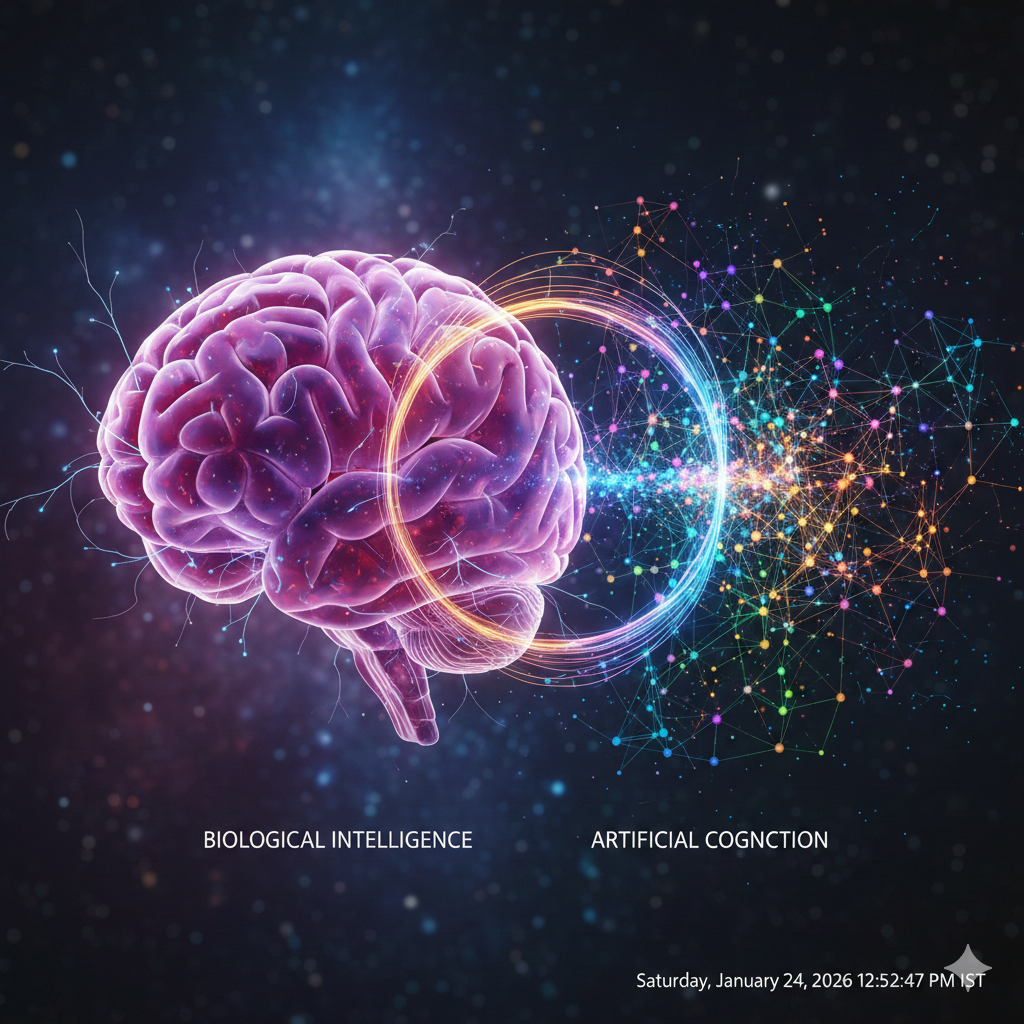

Artificial Intelligence has evolved from science fiction to an essential force shaping our daily lives and global economies. Once confined to academic papers and speculative movies, AI now powers everything from your smartphone's voice assistant to life-saving medical diagnostics.
What Exactly is Artificial Intelligence?
AI refers to computer systems designed to perform tasks that typically require human intelligence—learning, reasoning, problem-solving, perception, and language understanding. Unlike traditional software programmed with explicit rules, AI systems learn patterns from vast amounts of data.
The Three Waves of Modern AI
1. Narrow AI (ANI) - Specialized systems excelling at specific tasks like image recognition, language translation, or game playing. This is the AI that surrounds us today.
2. General AI (AGI) - The theoretical next step: systems with human-like cognitive abilities that could perform any intellectual task. While not yet realized, researchers are making steady progress.
3. Super intelligent AI (ASI) - A speculative future where AI surpasses human intelligence across all domains—the subject of both excitement and ethical concern.
How AI Actually Works: Machine Learning & Deep Learning
At AI's core lies machine learning—algorithms that improve automatically through experience. The most transformative subset is **deep learning**, inspired by the human brain's neural networks
"Deep learning has given computers extraordinary new capabilities, from recognizing objects in images to translating between languages in real-time," explains Dr. Elena Rodriguez, AI researcher at Stanford. "The breakthrough came not from better algorithms alone, but from three converging forces: massive datasets, powerful computing, and novel neural architectures."
AI Transforming Industries
a) Healthcare Revolution
AI algorithms now detect diseases earlier and more accurately than human experts in some cases. From analyzing medical images to accelerating drug discovery, AI could help address healthcare's biggest challenges.
b) Climate & Environmental Solutions
AI optimizes energy grids, models climate patterns, and helps track deforestation. Google's AI has reduced energy consumption in data centers by 40%, demonstrating technology's potential to combat climate change.
c) Creative Frontiers
Far from replacing human creativity, AI has become a collaborative tool for artists, musicians, and writers. Tools like DALL-E and Mid journey don't create art from nothing—they extend human imagination through new mediums.
As AI advances, critical questions emerge:
**Bias & Fairness:** How do we ensure AI systems don't perpetuate human prejudices?
**Transparency:** Can we understand why AI systems make particular decisions?
**Employment:** How will we adapt to workforce transformations?
**Autonomy:** How much decision-making should we delegate to machines?
"The most urgent need isn't smarter AI, but wiser governance," says tech ethicist Marcus Chen. "We need international standards, diverse development teams, and continuous public dialogue."
The Road Ahead: Human-AI Collaboration
The most promising future isn't AI replacing humans, but **augmenting** human capabilities. Surgeons using AI-guided precision tools, scientists analyzing data patterns invisible to the human eye, educators personalizing learning for each student—these partnerships showcase AI's true potential.
Embracing Our AI Future
AI represents one of humanity's most profound creations—a mirror reflecting our intelligence, our biases, and our aspirations. As this technology continues to evolve, our challenge is not just building more capable systems, but ensuring they align with human values and benefit all of society.
"The final question about AI may not be technical, but philosophical," suggests futurist Lila Thompson. “What kind of future do we want to build, and how can this extraordinary tool help us create it?”